Saturday, July 14, 2012

Hot zone in the Cold War

It was the autumn of 1962 and the world stood on the brink. It was the time of the Cuban missile crisis and it was the peak of the cold war. War could happen any moment and we would have less than a half hour before nuclear bombs would wipe us out. I lived in Somerset County, NJ and figured the duck-and-cover drill was simply a matter of protocol because if the bomb hit, I would be in a good position to kiss my ass goodbye. Of course, it the bomb did drop, I wouldn’t have time to kiss anything goodbye.

Though I have lived in the New York City metropolitan area all my life, I just discovered that the Soviet Union aimed more nuclear missiles at rural farmland in South Dakota, my newly adopted state, than at New York. The reason? Places like Exit 127 along Interstate 90. I couldn’t even begin to tell you what town is at that exit. The highway signs do not tell you. Go off at the exit and to the south is a paved road heading to farmland. And to the north is a dirt road. The Soviets had three nukes aimed there. Why? Just off the dirt road was Launch Facility Delta 01, an innocuous building that housed the control center for firing 10 Minuteman ICBM missiles armed with 1.2 megaton warheads aimed at Moscow.

If Soviet missiles hit their target, everything within a 40-mile radius would be annihilated. Back in 1962, President John F. Kennedy referred to the Minuteman missiles as the nation’s “ace in the hole.” The missiles were what were known as a deterrent. With their solid fuel instead of the liquid propellant seen in space program missile launches, they could be launched within five minutes. The certain knowledge that if the Soviets launched a nuclear attack on us that we would retaliate within minutes of their launch assured mutual destruction, the end of mankind.

Most of us knew about these sites. They were “somewhere” in the Midwest, but most of us never knew for sure where they were. But the Soviets did. Nationwide, there were 450 Minuteman missile launch sites. Following the 1991 Strategic Arms Reduction Treaty (START) signed by President George H. W. Bush and Soviet Premier Mikhail Gorbachev, the launch sites were destroyed. Delta 01 and a nearby launch silo, Delta 10, were preserved as a historic site.

We tend to forget that the Interstate Highway System, often called the “Eisenhower” Highway system after President Dwight D. Eisenhower who led its construction, was designed for national defense as well as transportation. That reality became quite apparent as most of these launch sites were manned by personnel from Ellsworth Air Force base, located near Rapid City.

Personnel from Ellsworth travelled to the sites for three-days on/three-days off shifts. On the ground floor, six enlisted men would staff the facility, mainly providing security support and support for the two officers who were underground in a steel bunker designed to withstand the earthquakes caused by the launching of ten missiles or an attack. Now you might think that the officers would be seasoned and mature. In fact, most of them were just out of officer training and on their first assignment. The thought was that younger men would obey orders better than older people, especially if they were married and had families. Our tour guide related a story about how the wife of one officer asked her to call if the missiles were launched. The man said “sure honey,” but the fact was that the missiles had to be launched within five minutes and the wife, living near Ellsworth, would be dead no matter what happened, as a nuke would surely hit it.

The officers and staff knew that if the keys were turned and buttons were pushed, they were dead. Incoming missiles were already launched. If you stayed in the underground control center, you would have about 24 hours of air before dying, far too soon to emerge and be safe from radiation.

Security patrolled the area in a Peacekeeper armored vehicle with a machine gun mounted to the top. The missile silos were surrounded by chain link fencing and if touched, would set off an alarm. And the men would respond right away. The Peacekeeper was nicknamed the “coffin car” because its air conditioner would burn out the engine in the summer and the heater didn’t work well in the winter. South Dakota has summer heat of 100° every day I’ve been here and is often among the coldest areas of the continental states in winters.

The most frequent causes of these alarms were tumbleweeds or cows. Our guide related a tale where a second Peacekeeper was called out because the report of the first group was very suspect. A camel had set off the fence alarm. It turned out that the beast was from a nearby zoo facility and was lent to a church for a nativity pageant. It panicked and bolted. .

Delta 09 and nearby missile silo Delta 01 are now historic sites run by the National Park Service. And tours are given. Park rangers give photography of the living quarters and underground feasibility. The launchntrol area has three circular spots that appear to be missile silos, but are actually antenna facilities. The site would have “soft” antennas that could be destroyed by an attack, but cement bunkers contained “hard” antennas that could be raised afterwards. The missile silos are actually at least a mile away, with special cable wiring connecting them to the launch center. There were no launch control personnel anywhere near the silos.

And so I emerged, relieved that the cold war is over and we are not anywhere near the end of life. But then I read the brochure: “There are no longer active ICBM silos in South Dakota, but 500 nuclear missiles are still deployed in the upper Great Plains. While threats of the Cold War era have subsided, the nations defense systems remain on alert.”

I’ll look for you when the war is over, an hour and a half from now.


Sunday, June 24, 2012

Nebraskan Surprise

It was one of the most pitiful excuses one could have to take a road trip. But I was lonely and fed up with feeling sorry for myself. So I decided to visit Nebraska.

On the way to Sioux Falls, South Dakota where I am presently camping, I had entered Sioux City, Iowa. It was very close to the Nebraska border and I had never been to Nebraska. I was tempted to divert for the 30 miles or so and cross over the border, but I hadn’t slept at anyplace but rest stops for four days and I was tired, cranky and gas was being consumed at a way higher rate than I wanted.

But I had been in Sioux Falls for several weeks and it was time to explore. I had been buried in front of the computer for most of the day, and taking naps as well. And it was suddenly 3 p.m. I had to get out and do something as I was driving myself crazy and Pup, the pup who is no

longer a puppy, kept giving me a look that reflected my mood: “Let’s do SOMETHING other than hanging around the trailer,” the look said. I knew it well. Pup needs to go to a place where he can find something new to smell and walk around. Ever since I adopted him, he had peed in every state we had visited, so why not add another one?

The Nebraska border was only about 70 miles away. And where we are, the sun doesn’t set until around 9:40. My friends on the East Coast may wonder about that, but South Dakota is in both the Central and Mountain Time zones. The Mountain Time zone is about 100 miles away and so it sets later than an Eastern Time zone.

So, even though it was late in the afternoon, there were still more than six hours of daylight left. So we climbed into the truck and headed south. My earlier route as I drove from Iowa to South Dakota, involved taking Interstate 80 west and then driving North along Interstate 29, which is a North-South route in the Southeastern part of South Dakota, linking I-80 with I-90 over about 100 miles. When I headed for Nebraska, I figured I would just go back Southbound and continue West on I-80 into Nebraska.

But I stopped at a gas station at the Vermillion exit at Route 50 and they had a local road map that showed if I took State Route 50 West I would save at least 40 miles. And I was truly sick of interstate driving. I like to get some local color. So I set the GPS for a town called Newcastle Nebraska and started driving. As with most of Southeast South Dakota, there are lots of Corn fields and not much else. And I suddenly found myself approaching a large bridge when I beheld the Missouri River for the first time.

When I crossed the Mississippi River, it was along I-80 by Grand Rapids, Iowa. I didn’t get much time to enjoy it, as there was heavy traffic. But this bridge had no traffic at all. I pulled over and shot a few photos, thinking I would then cross over and return. But just as I entered Nebraska, there was a sign for a scenic overlook and I drove up and was rewarded with an incredible view. The bridge is located at a spot where the river bends and it is not only pretty, but also impressive. It reminds me of the power that moving water has. Over the year, a huge island of sand from upstream erosion had been created in the middle of the river as it deposited it at the bend.

As I was looking at this scene, a photographer with a tripod came back from further uphill and he told me there were four different viewing places. So I started climbing. Pup gave me a look that said, “It’s about time.” He loves to go hiking with me and he immediately broke into his unmistakable grin of sheer joy as he climbed stairs and dragged me along.

We had a blast. He sniffed and marked his spot everywhere and with each observation level we reached, the views were even better. Eventually, we reached the end of the trail and I realized something was quite different. We were up pretty high. While we weren’t in mountains, we were on some pretty steep hills. It’s quite a contrast. On the South Dakota side of the river, the land is fairly flat and filled with corn and soybean fields. And it was just the opposite on the Nebraska side.


Even though I had accomplished my silly objective of visiting Nebraska, I decided to drive a little further into Newcastle. It was about five miles away. As I moved away from the river, I noticed something else was different. The hills were filled with fields that were clearly cultivated but here it was in the first days of summer and nothing was growing on them. I suspected that it might be a grazing area for livestock and I saw a few horses and a small herd of cattle. But then I saw a field with stacks of hay and I realized that this crop was the first harvest of the year.


Moving on a little bit, the cornfields re-appeared and the stalks were about two feet high. As I began my journey into corn country, which starts at the Ohio-Pennsylvania border, I had watched the crop grow from seedlings into an early crop where ears had started to emerge. Just about everywhere is fertilized. I saw fields that ran for miles without a farmhouse in sight. Yet the Nebraska farms were different in that they were on fields. I tried to imagine how tractors managed to maneuver around. Being raised on a farm,

the only terrain I had rode on was flat.

I reached Newcastle. It was a pretty little farm town with several churches, a town hall and a school. But there were no stores, gas stations or restaurants. I liked this place and wanted to leave a dollar or so in the local economy. I stopped and asked a couple leaving church services and they told me there was a restaurant a few miles down the road.

I drove a few more miles and couldn’t find anything but more farms. I decided to turn around and pulled to the side of the road to permit the minivan behind me to pass before doing my U-turn. I was stunned as they followed off the road and then pulled up to my right. They were at a very bad angle. They thought I needed help, though I had no idea how they could. I explained I was simply turning around and needed no help.

Suddenly we both were being harassed by a large black dog from the farmhouse we were in front of. He started to chase the minivan until it was able to pull back on the road and then barked furiously at us. Pup, who is generally a pacifist, does not have much tolerance for big dogs. I suspect he was once bitten by one and has a damaged ear to show for it. And so they engaged themselves in a rather spirited debate as I slowly did my U-turn trying not to hit the dog, which seemed rather suicidal.

And so we went back over the bridge and into South Dakota. I plugged in a Sioux Falls destination into the GPS and it took me back through the middle of Vermillion. It’s a really nice little town. I passed the University of South Dakota and its campus reminded me of the one where I graduated in Stony Brook, NY. It was also a smaller version of State College, PA, with a main street filled with fast food restaurants and other businesses catering to the college community.

As I reached Route 29, the sun was setting and I got some nice shots. One was a cornfield filled with the golden light of the sun’s last rays. A few minutes later, I shot another cornfield as the orange ball touched the horizon. As we continued to drive back north, there was a cloud that reflected the orange glow and twilight ended around 10:15 as I pulled off onto my exit.


So what did the road trip do for me? It renewed a zest for discovery; wondering what is around the bend. I’ve been thinking in terms of places like Mt. Rushmore, the Badlands and Yellowstone. But the true beauty of God’s creation often takes us by surprise.


Friday, June 22, 2012

Talkin' Baseball


Photo Captions: Top:At a Steinbrenner Field spring training game this April wearing my #9 Roger Maris shirt. Middle: My own personal "field of dreams" where I played baseball at Firemens' Field in Denville, NJ. Lower Middle: John sitting in Hank Aaron's locker at the Baseball Hall of Fame in Cooperstown, NY. Bottom: At the Yankees' ticker tape parade in 2009.

"The one constant through all the years, Ray, has been baseball. America is ruled by it like an army of steamrollers. It has been erased like a blackboard, rebuilt and erased again. But baseball has marked the time. This field, this game, is a part of our past, Ray. It reminds us of all that once was good. And that could be again. Oh, people will come, Ray. People will definitely come” Terence Mann (James Earl Jones) in Field of Dreams.

I cry at the end of this movie every time when Ray gets to have a catch with his dad. My father and I also had games of catch, and it wasn’t until many years later I realized the physical agony he went through to do it as one of his arms was destroyed in an auto crash. But I remember those days. Yes I do.

I was born in 1947 in Manhattan: 114 West 116th Street, Apartment 3A, to be exact. A few buildings to the West was Riverside Park where I spent many of my days from birth to about age five. Television was only an experiment and the radio reigned supreme. And even before I began to speak, I was listening to Red Barber and Mel Allen, Ernie Harwell
and others. The same year I was born a man named Jackie Robinson became the first African American (we called them “Negroes” in those days) to break the segregation that had held baseball captive for nearly a century. He signed with the Brooklyn Dodgers. Yes Brooklyn. In those days there were 16 major league baseball teams and New York City had three of them. In addition to the Dodgers, the Yankees inhabited the Bronx and the Giants were in the upper area of Manhattan.

It seemed as if one team, and often two, played for the World Series championship nearly every year. The first time I every watched television, we went over to my friend Jerry’s apartment to see the Yankees and Giants face off in the 1951 World Series. The Giants and the Dodgers had tied for first place in the National League and there was a three-game playoff that ended with Bobby Thompson's "Shot heard round the world" homer. My Mother rooted for the Dodgers, also known as “Dem Bums” They played in a band box called Ebbitts Field and had many stars but never managed to win a championship until 1955. They were immortalized in a book by Roger Kahn called “The Boys of Summer.” It’s been in print nearly forty years. I have a place mat with a picture of that Dodger team. My father grew up in the shadow of the Polo Grounds where the Giants played. And that was HIS team. I didn’t know much but the Yankees always seemed to win. And so I rooted for them.

In an effort to be fair and since tickets were only a couple of dollars for the best seats in the house and only a 15-cent subway ride, I wound up watching all three teams. I don’t remember very much, for I was only around three years old, but I am told I saw Joe Damage play in his last year. I also have a vague memory of shaking Jackie Robinson’s hand, as well as the other Dodgers. If you waited until they left after the game, they would talk to you and sign autographs. Today, if you go to a baseball card show, they’ll charge you at least ten dollars.
.
Even though I was too young to voice an opinion with much to back it up, there was always talk around both the house and the city as to who had the best center fielder: the Dodgers’ Duke Snider; the Giants’ Willie Mays and, of course, the incredible kid from Oklahoma, the Yankees' Mickey Mantle.

There weren’t many team sports that were popular in those days. Pro football had not taken hold. It was well known that if you went to his church on a game-day Sunday, you could get free tickets from Wellington Mara, the owner of the football Giants. The National Basketball Association had just started and frequently relied on a double header featuring the Knicks and the Harlem Globetrotters to fill Madison Square Garden. The Trotters, now a famous international comedy act, was a national pro champion in those days and Knicks games without the Trotters barely drew a crowd.

The big draws besides baseball was horse racing and boxing. In fact, my father was a professional boxer n the 1930s. He had won five straight as a middleweight and got on the Garden undercard once. He started to pound his opponent and the guy just smiled and proceeded to knock the crap out of him in the first round and knock him out in the second round. He realized that he previous fights had been fixed so a white guy could make the card. Blacks dominated he sport at the time, as they continued to do so for much of the 20th century.

But baseball ruled. I really became involved with it when I was in third grade when my mother got me into the Denville, NJ Little League.

We were the Hornets and played in tee shirts (which we had to return at the end of the season), bluejeans and PF Flyers or US Keds canvas sneakers. I was the worst player on my team, but a classmate was also on the team and we played every day in his back yard after school. In those days, I moved frequently, but I do remember one magic summer in a small town called Victory Gardens. The town had cleared a ball field and put up a batting cage and we would play on that field just about every day. There were no grown ups to supervise us, and that’s the way we wanted it. Every day after school and endless days throughout the summer we would spend from early in the morning until dark without going home. We didn’t even have water and didn’t care.

By then, television had become popular and at night I would watch the Yankees. I remember one stretch in the summer of 1958 where Yankee Catcher Yogi Berra had hit late inning home runs in about four straight games.

But we moved yet again and I eventually wound up at Bonnie Brae Farm for boys. And there we also played every day, usually in a sloping field where first base was a tree. We had a Little League team there but I couldn’t play. In most Little Leagues in the area, the maximum age was 12, which I was. But in this league, it was 11 and I watched helplessly as my friends played to an undefeated season.

In the 1960 baseball season, the Yankees had traded for a Cleveland Outfielder named Roger Maris, who won the most valuable player award that year. All the kids in school favored Mickey Mantle, but I stuck with Roger as my favorite. The next year was the incredible summer of 1961. That year Roger and Mickey hit home run after home run and both were in a race to beat Babe Ruth’s single season record of 60 homers in one season set in 1927. Towards the end of the season, Mantle had an ulcerated hip and couldn’t play but Maris hit his 61st on the final day of the season.

By then, my father had forced my mother and Bonnie Brae to permit me to visit him and we went a few times to Yankee Stadium. He wanted to buy good seats, but I insisted in sitting n the 75-cent bleachers in right field so I could watch Roger. One day, the love of baseball was forever sealed in my heart. In one game, I saw Roger hit two homers into the area were I was. I wasn’t close enough to catch them, but “my” hero had come through. But then Mantle came up to bat. He drove a ball into the back wall of the upper deck in right field. I swear it was still rising when it hit the wall. If it had been a few feet over to the left, it would have been out of the park. And no one, not even the immortal Babe Ruth, had ever hit one out of Yankee Stadium. I later learned that Mantle’s right arm was severely injured and he had hit it with only one arm. About seven years later, in 1967, my company had given me some seats for a game at Yankee Stadium. I took my best friend, Bill Stevens, to the game and it was the last game Mickey ever played.

Some people describe those days as the “golden” era of baseball. And it certainly was, but I will never forget the last day of the season when Roger hit the record breaker. The stands weren’t even half filled.

In eighth grade, I was on the junior high team, but one day I hurt my elbow and my arm was pretty much shot for that year. The next year I played Freshman Baseball at Morristown High School. I wasn’t very good at baseball, and I rarely played in the field, unless we were getting clobbered, which happened a few times. I usually would get to pinch hit late in the game. But I had an incredible string over the course of the season. I never got a hit, but never made an out. In my first at bat, I was hit by a pitch. Other at bats resulted in walks. I hit a grounder to a second baseman who bobbled the ball and I reached safely on an error. And one day I struck out, but the catcher dropped the ball. If a catcher drops a third strike, the batter could try to get to first and I made it. But my spikes caught in the bag and I wrecked my knee. I tried to play football that autumn and baseball the next year but the knee just wouldn’t hold up. Not that I had much talent anyhow, but that group of freshmen won the state championship when we were seniors. It would have been fun just to have ridden the bench for that great season.

By then, the Dodgers and Giants had left for the West Coast and there was suddenly a new team in town, the Mets. I can’t say I have been much of a Mets fan, but I did see them play the Dodgers once at the Polo Grounds in their first year. When I became a father, I took John to a few games with our church’s scout-type group, the Royal Rangers, and we also visited the Baseball Hall of Fame in Cooperstown, NY. He still has the baseball cards we bought that day and I think some of them are worth quite a bit of money.


One of the first dates with my wife was to take her to a Yankee game. She hated it. So I sometimes took my mother to a game. We shared opening day weekend when Yankee Stadium was refurbished in the late 1970s.

Although I did have some catches with John as a child, it was less often than I wished and he never really became interested in doing sports. Matthew was a big basketball player and fan but despite his coach and I trying to have him play baseball, he refused. Neither boy is a fan of the game today, though Matt has followed it loosely. The closest major league baseball team near John is the hapless Seattle Mariners and I doubt if he would ever make the trek to attend a game.

In the last years of my marriage, we got cable television and I was able to frequently watch my Yankees on the YES network on a little 13-inch television in my room. This was the Derek Jeter age and championships were won. But I couldn’t afford to go to a game where the prices had ridden up to $35 for a nosebleed seat. The last major league game I took in was at Yankee Stadium in the spring of 2001 when I chaperoned a group of the children I was teaching to a game. We watched Roger Clemens pitch in a year he won the Cy Young Award as the best pitcher in baseball.

As I write this, Clemens was just found innocent of lying to Congress when he claimed he never took steroids. This issue has made dramatic changes in the game and we may never see the incredible home runs or power pitching we saw in the 1990s.

In 2009, the Yankees won the World Series. I managed to go to the ticker tape parade down the canyon of heroes in
lower Manhattan. I couldn’t get anywhere near the players, but managed to have a blast anyhow. It was the only ticker tape parade I had ever attended. In 1959, I begged and pleaded with my mother to let me go watch the one for the original seven American astronauts after John Glenn had gone around the earth three times. I was in 6th grade and mom wouldn’t let me go. I stayed at home that day and watched every minute of the television coverage.
For the past two winters, I have managed to get to Florida to watch spring training games. One year I was lucky enough to be there when they gave away replica World Series rings. I sometimes wear mine, but keep in safe in my dresser. I might wind up watching spring training this winter in Arizona.

Living on the road has its issues with baseball. I don’t get to see many games unless the Yankees are playing a nationally televised game on ESPN or Fox and I happen to be in a campground with cable television. I'm looking forward to seeing the Yanks and Mets square off on Sunday night. But I did attend a game with a friend recently that reminded me why I love the game so much. It was a Little League game her grandson was playing in. It was filled with errors, bad pitching, poor hitting and a bunch of kids who just loved being there. It brought me back to the time when I fell in love with a game more than half a century ago. If only my other love lives were that successful.


Tuesday, May 29, 2012

Memorial Day, 2012


It is just before midnight as Memorial Day winds down to its last moments. I have just returned to my campsite and it is very unlike the last two nights of revelry as nearly all the campers have left. The Saturday night DJ and Sunday night family movie are silent echoes now, moments to be remembered. Most of my seasonal trailer-owning neighbors have returned to their homes, waiting, perhaps, for more summer to bring them back full time. All of the tent campers have disappeared, as have the overnight and weekend RVs that filled the campus and the swimming pool by day.

There is a group of people at a couple of rented trailers who come here every year for a week. They are still talking loudly, but it disturbs no one as everyone else has either departed or is distant enough for the sound to remain muted. The sky, too, is different. There is a nice half moon and stars, all under a slight haze. Last night there were rain sprinkles and much heat lightning to our north.

But my thoughts have little to do with my environment. It is thoughts of the day. For Memorial Day is not National Bar-B-Que Day, but a time to honor our fallen heroes. Parts of this day were of things I have done many times before. Yet another part was a first-in-my-lifetime experience. And there was also a few moments of sorrow and sadness.

Earlier this week I wrote about a visit to the grave of my father’s family. My father had been in the Army National Guard during the depression. But his arm was mangled in an auto accident and he never served in a war. I have no idea if his father did. I went to the family plot because I discovered the deed to the cemetery. I had not seen it in many years and it always seemed to disappear after its discovery. And so, I travelled back there to a place I had not been since 1972.

After that day, I discovered a piece of paper in my mother’s handwriting tucked inside the deed. I realized it was a cemetery grave number. It didn’t match that of my father’s family. Could it be my mother’s parents’ grave? With this information, and the help of a cousin. A long-lost location in Jersey City was found.

I had never visited this gravesite. I had known little about my grandmother, Margaret, and even less about my grandfather, other than he was a soldier who died in the First World War.

And so I became determined to find this bit of my heritage and Memorial Day was a clear choice. My GPS worked perfectly and I arrived at the cemetery just before 11 a.m. And I attended a memorial mass conducted by the bishop of the Newark Diocese. Though I grew up Catholic, I had never attended a Mass conducted by a bishop and it was interesting to note how the other priests interacted with him. The grave is in a Catholic cemetery. It was first built for Jersey City’s German immigrant population and eventually was dominated in the era of my grandfather’s death by the Irish. And among the current Knights of Columbus in attendance were several of Asian descent.

In front of me was an elderly gentleman clearly fighting to perform the rituals of the mass, mainly standing. Wearing a heavy suit in what was close to 90-degree sun, his face poured sweat at a profuse rate as he struggled to stand up. He nearly fell a couple of times and I made it my business to brace him a couple of times as he sat down.

My cousin Rita had called the cemetery the day before and confirmed our family was buried there. Rita is the eldest of the Gavin-Alford-Rooney-Munzer clan of four cousins. Her mother, Nellie Rooney, had three children and my mother, Nellie’s sister Peggy, had only one child, myself. Their maiden names were Alford. Nellie had married a man named Luke Rooney and Peggy, my mother, had married John Munzer. Our grandmother’s maiden name was Gavin, and Nellie named her first-born son that to carry on the name. My son’s middle name is Alford and he is probably the last of the Alfords unless one of my cousin Luke’s children tosses in that name somewhere.

But the person in the office could not find the grave in the computer. And so I spent some anxious moments and phone calls with Rita before the foreman of the gravediggers took us to the gravesite.

And sure enough, there it was. James Alford, Margaret (Gavin) Alford, and a bit of a shock. It turned out that my mother had a second sister, Mary, who had died at the tender age of 12 as the result of scarlet fever. I had never remembered hearing the name mentioned though my cousin said she me told me about her on my visit to her Maryland home earlier this year.

And so I gazed at the tombstone. It provided some perspective, a bit more about the person I am. Another moment in my search for my personal truth.

The cemetery is only a few blocks away from the Holland Tunnel, which takes you to lower Manhattan. On Facebook earlier in the day, a friend on Long Island posted about how he was having a bar-b-que that day and I sort of invited myself. But I did so for another reason. . .a Memorial Day tradition that I have carried on even after my divorce, visiting my father-in-law’s grave at the national cemetery in Calverton.

I can’t remember ever having taken the Holland Tunnel into New York, but I eventually found myself forced into the Manhattan Bridge into Brooklyn and I realized I would be travelling through Greenpoint, where my ex-wife’s family comes from.

Months ago, I had packed up my apartment and had a bunch of photos of my nephews growing up. I had placed them in a mailing box and several times asked my ex’s sister for an address to mail them to. Since I was in the neighborhood and had been carrying the box in my car for months, I decided to drop it off at their apartment.

So I rang her bell and the speaker was complete static. I could not understand what was being said. Someone in the hall let me in and the elevator was out of order. I walked up the five flights of stairs to their apartment and knocked. The sister told me she would not let me in without a police officer present. I told her all I wanted to do was give her the photos and left the box at her door. It is a sad footnote to a vicious divorce. If any member of her family reads this, please let her know that I had no intention to scare or upset her. I just wanted to give her a bit of her family’s history and I hope she enjoys the photos.

I still do not fully comprehend why I visit my late father-in-law’s grave every Memorial Day. I used to escort my ex for a couple of years. But then one year she was hospitalized and other times the weather was too cold or hot. It seemed I wound up laying flowers and flags at the site each year. Wounded in Africa during the Second World War, he spent the decades I knew him discussing the war. After his death, I submitted the many papers he had collected about the war to my university’s history department.

Even after I left my ex, I continued this visit. I think there are two reasons for it. The first is that he was wonderful to me when he lived. He was certainly a surrogate father. The second was his family, city dwellers, often do not have the transportation to get there. And so, who is there to honor him?

And so I once again made my visit, laid my flowers and set up flags. And as each year passes, the number of flowers in his section containing about a thousand graves seems to decrease.

Several years ago, I met a man who went to more than 40 different sections at the cemetery and played Taps at each site. It was his way of honoring the fallen heroes. He wasn’t doing for with any group. Just something he chose to spend this day doing. Now I neither have the talent nor physical stamina to do something like that. But I did want to give honor to more than just my father-in-law. And I decided to give a salute to each of his eight neighbors – the three in front, three in back and two as his side.

I have been visiting a number of cemeteries in the past year. In addition to my family, a friend lost her father who was buried next to her late husband. It was today as I was making those salutes, I realized the difference between the private cemetery I had visited earlier in the day and this National Cemetery. Both places are sacred ground. But at a private cemetery, one takes away memories of the past. At this cemetery, one gives honor to the present.

So I left and travelled to my friend and had dinner with his family and some friends I hadn’t seen in a long time. My host truly knows how to grill a steak. And then as darkness fell over the region, I crossed bridges into New Jersey for a return to the campgrounds.

As I drove home (home being where I park the trailer these days), I thought how some of the pictures I took might someday benefit my granddaughter, whom I expect to see for the first time in several years by the end of June. When I was young, only one of my grandparents was alive and he was beginning to be senile. Lydia has the benefit of four grandparents and I hope that somehow we can all bring her a sense of joy and her place in this world. Here’s hoping she knows that there are heroes in her genes.

Wednesday, May 23, 2012

Third World Education


"Lamenting that millions of American children receive “a third world education,” Mitt Romney on Wednesday called for poor and disabled students to be able to use federal funds to attend any public, private or online school they choose." – New York Times article posted on May 23, 2012.

First of all, third world countries wouldn't put up with the behavior kids perform in our schools. They kick them out. Secondly, the problem isn’t the schools. It isn’t the teachers. It isn’t the parents. It isn’t the students. It’s the law. It's the "blueberry" principle.

Teachers know about the "blueberry principle." One time a man who ran a prosperous ice cream company was speaking at an assembly of teachers berating them for not doing things in a businesslike manner. The man noted his blueberry ice cream was judged the finest in the land.

After the ranting and raving, one teacher quietly raised her hand and asked what the ice cream person did with blueberries that didn't meet his standards? At that moment he realized that public schools had to take everyone, no matter what quality they were. He formed a foundation to support public education.

Now people my age can look back with thoughts that getting in trouble meant smoking in the bathroom or chewing gum in class. We were taught manners in kindergarten and were expected to use them. Our schools had dress codes and we had to wear uniforms for gym. If we weren’t passing our schoolwork, we couldn’t participate in sports and other activities. And Lord help you if you skipped school.

We felt safe. We knew there were troublemakers and knuckleheads in the school, but we never seemed to be in the same class.

But the law changed that. The concept of equal rights and opportunity has become so much out of control that we are indeed in a third world educational system.

Let’s look at some of these laws. The main offender is what might appear to be a seemingly innocent change in the policy for special education students. Before 2000, the law stated that they were to be placed in the “most appropriate” environment. But then the law changed. It now reads they should be in the “least restrictive” environment.

Let’s translate that in cold hard facts: In 2000-2001 school year, I taught in a public school in the South Bronx. The overwhelming majority of the special ed students were classified as emotionally disabled. This comes from parents who were both drug and child abusers. In every case of children classified in this category, those who had problems like ADHD had drug-using parents during pregnancy. What’s more, the parents refused to put children on medications to calm them down. It is both a denial that they caused the problem and a cultural issue in the community.

Now these students were placed in either classes of 12 or 6, depending on the extent of their problems. And along with each teacher, there was an aide. The children could be handled and learn to some extent because the teachers understood problems the children faced. For example, a child with ADHD has difficulty trying to understand what is being taught. If the teacher moves on to the next statement, he remains on the previous one. He becomes frustrated and angry. Teachers are trained to spot this and go back and ask the student what they understand.

Fast forward to the 2001-2002 school year. The year starts out much the same as every year. But then 9-11 happens and there is a great deal of trauma. In the meantime, a court – a judge – decides that the new policy isn’t being implemented and demands the school change immediately – and he tells the schools how to do it.

And so they moved nearly all of the students into a mainstream class. The concept of this class is that two teachers work together to provide both groups of students with proper instruction. It just doesn’t work. Classes are “dumbed down” to permit the special ed students to learn, but the constant attention given in a 12-student class with an aide to help isn’t possible in a 32-student class with half the students having special needs. And the students continue to fall behind, as they are unable to process at the speed of even the “dumbed down” course of study. And so they begin to act out. The regular-ed students are easily distracted and classes became places of entertainment, not learning.

Now there is also another issue here. There aren’t anywhere near enough special education students to go around. It takes a certain mentality to teach special ed and many teachers did not want to teach these students. The state education department wisely decided to include special ed courses in order to obtain teacher certification. But most of the teachers were tenured for decades with permanent teaching licenses. They don’t have the training and won’t be required to get it.

And the fact is they just don’t like teaching under this new system. But when one has decades invested in a job, it is nearly impossible to leave. Many teachers were offered “buy outs” of as much as four years of salary, but many refused it because of the way it would affect pension benefits.

Law number two is also one of chaos. Throughout our country, there are millions of illegal immigrants. By law, their children must be educated. The law assumes that many of these children were born in the United States and are therefore citizens of this country. And they are entitled to the benefits accorded a citizen including an education.

But they don’t speak English. And their parents don’t speak English. In case you haven’t noticed it, the law demands most products now have a bilingual label. So unlike immigrants of years ago, there is far less pressure to assimilate. Thus, the law requires that we have bilingual education for those who need it.

This is an absolute necessity. However, there are many problems that go with this. One of the most frustrating cases was with Jose, whom I taught in both 7th and 8th grades. Jose was the son of two hard-working immigrants. The father worked two jobs in kitchens for 16 hours a day. The mother cleaned offices. But their education from their homeland, in this case the Dominican Republic, was practically non-existent.

Jose never attended school in his homeland. He was placed in a bi-lingual class and quickly learned enough English to function. But here at a middle school level, he was expected to perform middle school tasks. He could add and subtract single digits by using his fingers. But that was all the math he had. He was unable to perform simple tasks like handling money. He could not read in either language and did not have the ability to study more advanced work.

This kid was bright. He could learn. But there was nothing the system could do to help him. And when administrators realized he had learned enough English, he was moved to an all-English class.

All this reinforces Mr. Romney’s contention. But what do we do about it. “No Child Left Behind” was an absolute failure because of Jose and the mainstreaming of special ed students. These are not issues of passing tests, nor is it of teaching. They are societal issues. It won’t matter what school you go to if you are handcuffed by these laws. Romney says private schools should be included. But what private school wants to have emotionally-disturbed students and if they accept regular students under any this kind of program, that probably means they would have to accept all students. Thus the brightest children in public school will have to remain there.

So what must be done to solve this? I haven’t a clue. I don’t think it will be solved in our lifetime. But I do have an idea. It’s an old one. It’s called “states rights”.

Why are there so many federal statutes about education? The answer is that for many decades in the last century, states in the South spent way less educating their children than in the rest of the country and the result was the court and federal government intervention. The only way I see of straightening out this mess is to tear it down and start again. What I think might – I repeat might – work is for an amendment to the constitution to be passed that states: “The responsibility for the education of children shall be entirely the province of state governments.”

That way, state governments could once again formulate policy. The issues of education in the state of New York are entirely different from that of South Dakota because the social dynamics are entirely different. States need to formulate solutions for their own needs, not conform to federal demands, which, by the way, usually come without the funding to implement them.

The last time anyone tried to amend the constitution was in the 1970s, and the women's rights amendment was never ratified by enough states. It would be impossible to pass one involving education.

So my only point to this collection of around 1500 words is that I sincerely hope that my son and his wife have enough wisdom to know how to educate the world’s most beautiful and brilliant child.

Tuesday, May 22, 2012

A matter of grave importance

The deed I discovered that led me back to my Father's family grave.The location of the grave: Section 94, Lot 233, at the Mt. Hope Cemetery in Hastings-On-Hudson, NYThe tombstone. My father never added his father and sister to the site and I was in the Army and pending assignment in Germany. I never filled the names in, but arranged to do so. I still need to find years of birth for Pop and Tess.

* * *

I was there perhaps twice in my life. Once in the 1940s when I didn’t know about what it was and a second time in 1972 when I knew too much about it. I haven’t been there in four decades.

It is Section 94, Plot 223 at the Mt. Hope Cemetery in Hastings On Hudson, New York. My father’s family “lives” there.

The plot was purchased by “Pops”, my grandfather on the day before Valentines Day in 1946, before I was born. I guess “Pops” was in a lot of pain that day. He was burying my grandmother, Anna, whom family lore says she died from pneumonia.

I didn’t know Pops (Joseph Munzer) very well. He died in 1954, when I was seven. But he had been in poor health for many years and was somewhat senile when I was alive. Generally, I saw him on holidays and my birthday. He was sort of someone who was in the background. I was born in New York City and our family moved to rural New Jersey in the early 1950s to a small house in Cedar Lake, Denville, New Jersey. Pop came to visit and fell asleep on the couch by the fireplace. My dad started a fire to keep him warm and he woke up screaming in terror declaring he died and had gone to hell.

It wasn’t too much later my parents told me Pop had died. But because there was so little contact, I didn’t have many memories of him. My father once told me that he and his brothers worked for a local brewery delivering barrels of beer to speakeasies during prohibition in the 1920s. He said these guys were so strong that they would sometimes pick up and remove a full barrel as if it was empty for their personal use.

He was buried next to Anna, but the tombstone was never updated, nor was it for my Aunt Tess, who died when I was a high school senior.

Tess was someone whom I had known as a youngster, but wasn’t very close to – especially after my parents separated. As I grew older, my father demanded I spend time where he lived in Manhattan and we would frequently meet at the Woolworth’s on 34th Street and 7th Avenue. It was near Macy’s and she often took me shopping for things like a good suit. Tess was a camera buff and loved to shoot photos of flowers. She had a keen eye and tried to show me what to look for when taking pictures. Sometimes a memory or two came back as I had a career in photography for many years.

I sometimes felt I was taking advantage of her. I didn’t like to exploit her, but my father insisted that she wanted to buy me things as she had never been married and I, an only child, was the only living relative she had other than my father, her brother. I didn’t realize it at the time, but the things she bought me were things I needed and couldn’t afford. For example, as a junior in high school, I wanted to learn to fence. She got me a foil and a fencing mask and I took classes both in school and at the “Y”. As I look back, I realize how grateful I was for these gifts. I was kind of shocked at the visit to learn her name, as listed in the cemetery records, was not Tess, but Alicia Theresa. Tess was her nickname.

She worked for the New York City Transit Authority all her life and one day she told her co-workers that she wasn’t feeling well and was going home. Several days later, she was found dead. This was in 1965.

I wasn’t allowed to go to neither Pops’, nor Tess’, funerals. I don’t think my father had a funeral for her, but just a wake. What I do remember is cleaning out her apartment. Tess was the first person who I discovered was a hoarder. With her death, it was discovered her apartment hadn’t been cleaned probably for the eleven years since Pops died. Cans of his pipe tobacco were left where they were at the time of her death. Canned food had been expired for many years. She bought many things through mail order and unopened packages littered the floor. Among the items were record albums that came from a record-of-the-month club. I took those and what was left of her cameras. My father thought that the cops who discovered the body had robbed it as well.

People from my father’s church came to remove whatever I didn’t want. There was more than enough for a huge rummage sale. And a cleaning service was needed to scrub out the place and toss out the furniture.

As I write this, I realize that the trauma of that time impacted me during my marriage as well. Being found dead in a mess like my wife had created terrified me and I probably battled way too much with her. If you read this, I am sorry that I over-reacted.

And so I had a discussion with these people. While it was quite lively, I suppose it was one sided. On Facebook, I mourned the recent death of BeeGee Robin Gibb. A friend asked me if it really mattered since he couldn’t see it. I asked him how he knew that. It was just as possible that he could. Anyhow, I felt a presence that they understood what I said and also knew that my words were inadequate for my feelings.

The conversation with my father was somewhat different. I recounted many times when his visits reassured me. Sometimes he felt like an entertainer as he did things like take me to amusement parks, bowling and other kid attractions and also on my very first airplane ride, which my mother went nuts about. There was a time when I came home with a piece of steak that had fallen on the floor and I tossed it to my dog. It happened in front of the landlord just as my mother was telling him she was too broke for a rent increase.

I guess the most important visits were the times I was desperately alone. I remember when I was eleven just going to a local park and skipping stones. I don’t remember what we talked about, but I do remember calming down. Another time, when I was sixteen, my mother was going crazy and he visited me where I was working at the movie theater. He even paid for an admission. We sat for about 20 minutes with him telling me I was OK and that things would be OK. He then left. He had travelled two hours each way on a train to do this. It is one of the things I will never forget. In hindsight, I realize that about a week later I wound up seeing the school psychologist and wound up in his group. As I gradually opened up to the shrink about my mother’s drinking, the shrink arranged for a family to take me in until graduation if need be. I didn’t need it but it was nice to know it was there.

Both my parents were alcoholics. They had similar, yet very different, drinking patterns. My mother would sneak her drinks and then become very outgoing and friendly until she turned morose and belligerent before passing out. My father drank openly in front of me, also became more outgoing and friendly, but didn’t turn mean, nor did he pass out.

And so I talked to Dad about these things, and much more. And then I started crying. The sorrow that had lain dormant for about four decades finally came out. I had been in something of a depression and it helped snap me out of it.

It rained most of the day and as I went from the cemetery office to the gravesite, the original deed slipped out of the plastic page cover I had been holding it in. I discovered it missing as I left the grave and retraced my steps in a panic before finding it soaked on the road in front of the cemetery office. But it dried up and I still have it in decent condition.

As I drove home, more good memories about the Munzers came out. Just as earlier in the year when I visited a cousin on my mother’s side and discovered a photo of our grandfather who died in the First World War, more pieces of my past came together. One of the things my ex had was an incredibly large number of relatives and I always envied her sense of her place in the world. I guess it’s never too late to find some of your own.

Friday, May 11, 2012

View from the Rock

They call the place where I’m camping “Rockview Valley.” I spent the summer of 2011 here and am spending the month of May here this year as I continue to recover from my bout with double pneumonia. I always thought they named the place as a clever use of the “R. V.” initials since this is a RV park.

Google Maps view of the "rock" in the lower right. The campgrounds is in the upper left.

I had no reason to think otherwise for more than a year. By all appearances, we weren’t in a valley. We were in wooded campsites surrounding a grass field with a pool and pavilion for activities. You had to go slightly downhill to reach the tent camping area, but you never paid much attention to the geography. Towering trees behind the camping area blocked the view and because they seemed to be of even height for a long distance, you didn’t see the terrain. But there is indeed a rock and the view is awesome! The rock is called the Tri-State Rock because it offers views of New York and Pennsylvania from its summit in New Jersey

I don’t know how to describe the climb one takes to get to the view. It is too small to call it a mountain and way too large to call it a hill. The uphill angle is quite steep, anywhere from 30° to 45° depending on where you are on the trail that leads to the top. And it isn’t a rock, and it makes a boulder look like a pebble. I’m sure it is at least half a mile long. And the angle definitely is greater than 45°. I think it is granite, but I have no idea.

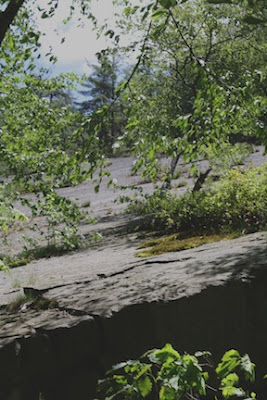
Looking up the rock from the campground. The shadowed area at the bottom was once the home of many rattlesnakes.

I discovered the rock yesterday while taking Pup, the pup who is no longer a puppy, on a walk. I visited a deserted area at the top of the tent camping area and found myself at its base. I’m an old man with a bum knee, weak ankles and shoulders with torn rotator cuffs. There is no way I could have climbed the rock itself (which is actually against campground rules). So I talked to John, the manager, about a trail and there was one.

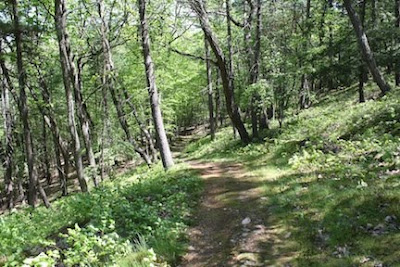
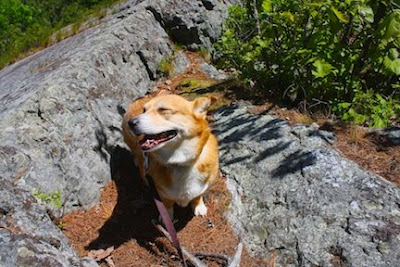
So the next day, Pup and I took the nature trail ascending to the top. Within a couple of hundred yards my lungs were heaving as I panted from fatigue. The trail was steep, very steep. And I began the first of my frequent rest stops. I would estimate that the steepest part of the walk was about the first quarter mile of what was probably a mile-and-a-half trail. But it was uphill all the way. As I panted, Pup had a huge smile on his face. He was in his element. As I thought about it, I realized that Pup’s breed, Corgi, was bred to herd sheep in the rocky highlands of Wales. Those short little legs, which handicap him on normal terrain, were natural for climbing rocks and jumping over fallen trees. He kept pulling me; something I was rather grateful for as the climb continued. I thought of a song called “I’m climbing my mountain one step at a time.” It is from a Christian children’s video featuring Psalty (pronounced Salty, but spelled like Psalms) a singing songbook. And so I did take things one step at a time, though is did miss the GORP* Psalty brought on his hike. Here's the link:

http://www.youtube.com/watch?v=QM46ME7pAoU&feature=related

Note angle of hill.

At one point, I stepped on a pine cone and lost my footing. I realized how easy it would be to break an ankle and what a fool I was for having left my cell phone back at the trailer to recharge. Memo to self: since you’re crazy enough to go through the wild territories of the Northern part of the United States, get yourself a phone with a GPS or at least bring the car’s GPS with you. It could save your damn fool ass.

While I had seen the rock from the bottom, it was not visible until I reached the end of the trail. And at first I was rather disappointed. At this point, there were many trees blocking the view of the valley below. I thought of a friend who is terrified of heights; and realized that without any barrier between the edge and myself, it was quite scary. Though I lived in many places as a child, a small cliff where I climbed backed one of the homes. I remember slipping on ice one day and falling down perhaps 60 feet. I sprained a lot of muscles and was sore for a week. I didn’t dare tell my mother because she would get angry. But the memory of the fall came back vividly as I thought how long a fall here would be. Memo to self: Besides the phone and GPS, let someone know where you are.

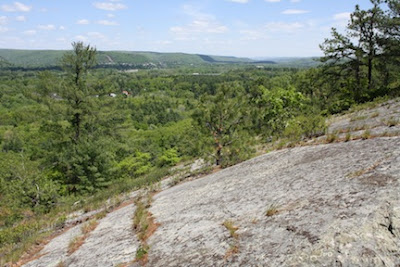
I turned to the North and realized that there was more cliff just about six feet higher and gingerly walked to it holding onto trees in fear of falling. Here the view was incredible. I could see across the Delaware River into the Pocono Mountains and my eyes went up the river to see the Catskills where I had just spent some time. There was a wonderful wind, about 20 mph according to the weather station on television. It cooled my overheated body and I enjoyed its caress as sweat evaporated from my face. There was only an occasional mild breeze at the campsite.

Top: View from the rock.

Bottom: Enlarged part showing truck on Interstate Highway 84 Bridge across the Delaware River.

I could see much of the area where I had lived for the past few years. I could see the top of the Wal-Mart and other stores. I watched as traffic moved across the Route 84 Bridge across the Delaware River between Pennsylvania and New York as it skirted the border between New York and New Jersey. I noticed the big grin on Pup’s face and gave him an extensive and well-deserved petting.

Pup, the pup who is no longer a puppy, was in his true element. Corgis were bred to herd sheep along the rocky hills of Wales and those short legs made it easy for him.

My pastor used to speak of “mountaintop experiences” when one became closer to God. I prayed a lot. I asked for guidance for the future as well as forgiveness over the past. I especially prayed about my relationships with women. The last year or so has been confusing and painful to myself and especially others. It is something I need to understand. Sometimes I feel I never will be ready for a relationship and other times I deeply want to have someone to live with, perhaps even marry. The thought of either can drive me into a major panic. It seems that every woman I know has faults. I know no one is perfect, but I use these faults to ensure that relationships end instead of enjoying the differences. They are barriers I use to avoid the good things. I suspect it is a result of my embattled time of divorce. Though I hope it is behind me now, it never seemed to end.

Finally I prayed that I would not fall down and break my crown and have Pup come tumbling after as I descended the trail.

Pup enjoyed the downhill part even more as he led me down the trail. He seemed to think of it as lots of fun instead of hard work. As we descended, I kept looking for the tree I had laid a small log on to mark the place where the trail splits. I was told that if I missed that point, I would wind up at a horse ranch and have to walk several miles to get back to the camp. I spotted the tree and looked up. There were two bright orange arrows painted on the trunk and a couple of hiker signs. I hadn’t noticed them on the uphill part of the journey.

We finally arrived back at camp and entered the trailer. Pup took a long drink of water and decided a nap was in order while I wrote this piece. After days of rain, the sun is out and the mild temperature and easy breezes make this one of the best days I’ve had in a long while. Hope your day is just as good – unless, of course, you have other plans.

*GORP = Good Ole Raisins and Peanuts